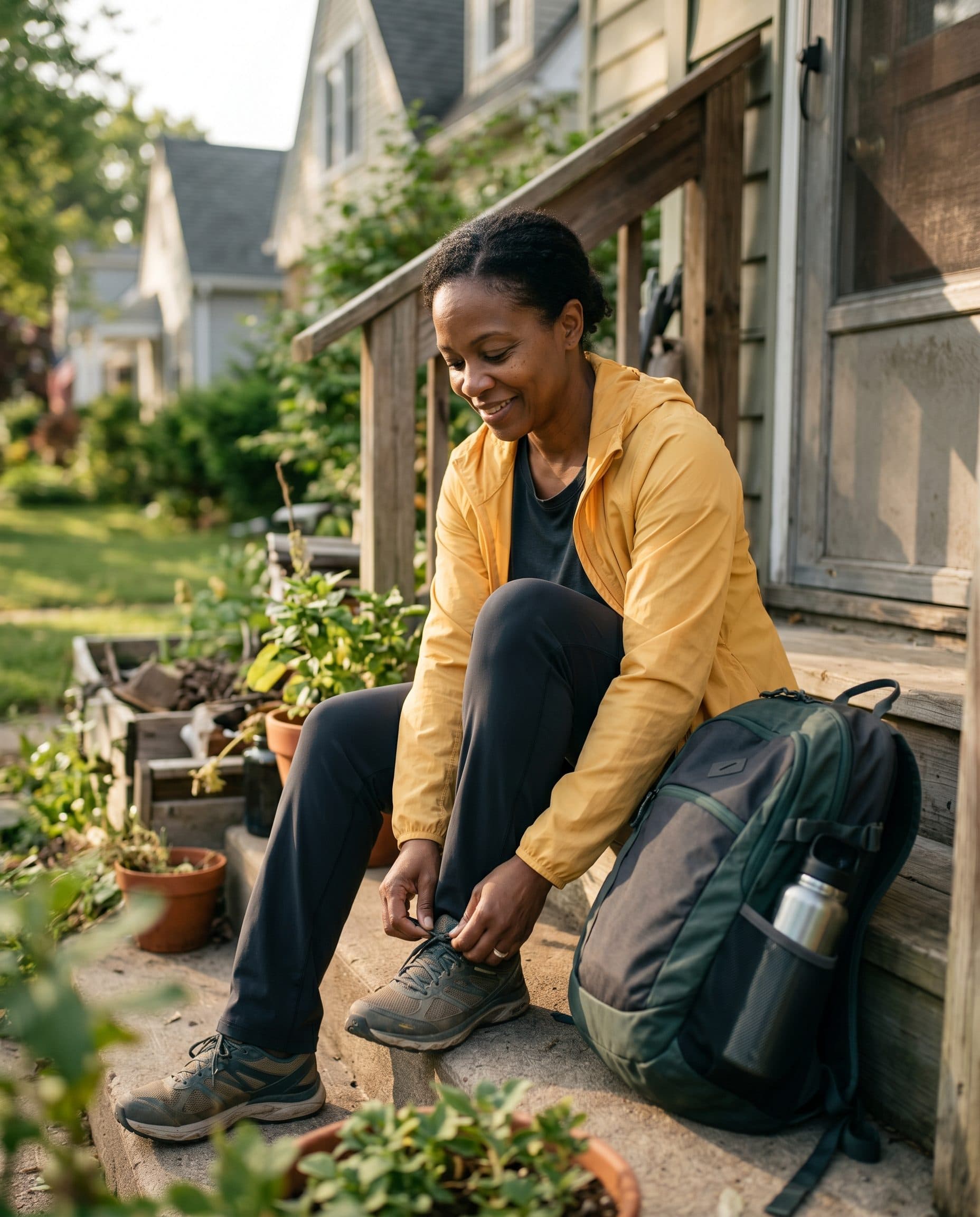
Starting to ruck is mostly about holding back. The walk itself you already know. The skill is choosing a load light enough that you finish wanting more, packing it so it doesn't pull on you, and building slowly enough that your body keeps up.
This guide takes you from your front door to your first few weeks: what you need, how to pack it, what your first ruck should feel like and how to know when you're ready for more. If you're still deciding whether rucking is for you, start with rucking for women: why carry weight.
Before you start: a quick check
Rucking is walking, so most women can start right away. But carrying weight adds load to your bones, joints and pelvic floor, so check in first if it applies to you.
Talk to your doctor or physical therapist first if you have osteoporosis or osteopenia; bone, joint, heart or pelvic floor concerns; or if you're pregnant or postpartum. They may suggest starting with no added weight or the lightest option, and that's a fine way to begin.
What you need
Less than you'd guess. You can do your first rucks with things you already own.
- A sturdy backpack. Padded shoulder straps help, and a chest or hip strap helps even more. A school bag or everyday daypack is fine to start.
- A little weight from home. Water bottles, a double-bagged bag of rice or beans, or hardcover books wrapped in a towel. Water bottles are the easiest: you can drink one to lighten up mid-walk.
- Stable walking shoes. The shoes you already walk in are a good start, as long as they have a firm heel and feel steady.
- A fitted top and a supportive sports bra. Straps rub less over a top with sleeves, and wide, smooth bra straps are more comfortable under a pack.
You don't need a rucking pack, a weight plate or a weighted vest to begin. If you're curious about vests, our guide to weighted vest vs rucksack compares the two.
How to pack your backpack
How you pack matters as much as how much you carry. A load that sits low or loose pulls you backward and makes your shoulders work harder than they need to.
- Lift the base. In a deep backpack, put a folded towel or a yoga block in the bottom first, so the weight sits higher.
- Weight high and close. Place the heaviest items between your shoulder blades, right against your back.
- Fill the gaps. Stuff a towel or a sweater around the load so nothing shifts, rattles or bounces.
- Snug the straps. Tighten the shoulder straps so the pack hugs your back, then fasten the chest and hip straps if it has them.
- Weigh it. Step on a bathroom scale wearing the pack, then without it. The difference is what you're carrying.
Not sure how much to put in? Our weight calculator gives you a starting range based on your body weight, fitness and age. It's deliberately conservative, and that's the point.
Your first ruck
Make your first ruck easy to say yes to.
- Pick a familiar route. A loop around your neighborhood or a local park you already walk. Somewhere flat, close to home and easy to cut short.
- Keep it short. Shorter than your usual walk. You're testing the pack and how your body feels, not proving anything.
- Walk at a talking pace. You should be able to talk in full sentences the whole way. If you can only manage short phrases, slow down or take some weight out.
- Bring a friend if you can. A walking partner makes the talk test easy and the walk go faster.
Many women do their first walks with an empty pack, or no pack at all, to get the habit and the pace settled before adding weight. That's how our free 4-week plan begins.
How to ruck: walking with weight
Good rucking looks like good walking with a pack on.
- Stand tall. Eyes ahead, chest open, shoulders relaxed and down, away from your ears.
- Keep your normal stride. Don't shorten your steps or shuffle. If the load changes how you walk, it's too heavy for now.
- Let your arms swing. Resist the urge to hold the straps the whole way.
- Don't lean into it. A slight forward lean on a hill is natural. A constant lean on flat ground means the pack is too heavy, too low or too loose.
- Take hills slowly. Shorter steps and an easier pace on the way up. Go gently on the way down, where your knees do more work.
If you're carrying in a weighted vest instead of a pack, our guide to wearing a weighted vest without pain covers fit, what to wear underneath and how to stop chest and shoulder aches.
After your walk: the body check
How you feel later that day and the next morning tells you more than how you felt on the walk.
- Green: keep going. Muscles feel tired or warm, and any mild soreness fades within a day.
- Yellow: ease off. Tight shoulders or neck, straps rubbing, or soreness that lasts into a second day. Next time, go lighter, shorter or slower, and stay there until it feels green.
- Red: stop and get advice. See the stop signals below.
Tired muscles are normal. Sore joints are not.
How to build up
Your muscles adapt faster than your joints and connective tissue, so slow progress is safe progress.
- Change one thing at a time. A little more time or a little more weight, never both in the same week.
- Add time before weight. Get comfortable walking longer with your starting load before you add to it.
- Add weight in small steps. Water bottles are handy here: one more bottle is a small, easy change.
- Leave rest days between rucks. Walk without weight on other days if you like.
- Hold when you need to. A week that stays the same is still progress.
If you'd rather not work it out yourself, our free 4-week plan sets out every walk, with simple strength moves and coaching emails along the way.
Know when to stop
Stop, take the pack off and talk to your doctor or physical therapist before you carry weight again if you notice:
- sharp pain
- pain that changes how you walk
- pelvic heaviness or pressure
- dizziness
- chest discomfort
These aren't things to push through. Rucking should leave you feeling capable, not hurt.
Make it a habit
The women who keep rucking usually have a reason beyond the walk itself.
- Put it in your calendar. Pick your ruck days and treat them like appointments.
- Find your people. Ask a friend, a neighbor or a walking group to carry with you. A ruck is a walk you can do side by side, at a talking pace.
- Carry for something bigger. Many women carry for a cause: in honor of someone, or to raise money for an organization they care about. If you're part of a nonprofit, women's group or workplace, you can host a ruck for your cause. Donations go straight to your organization.
Ready for your first ruck?
Find your starting weight with our weight calculator, then follow the free 4-week plan to build up one small step at a time.