Rucking and running both get you outside and moving. They just ask very different things of your body. Rucking is walking with weight on your back. Running is faster, with a moment in every stride where both feet leave the ground.
This guide compares the two honestly: how each feels on your joints, what each builds, who each tends to suit and how to fit both into your week. If you're new to rucking, our guide to rucking for women explains what it is and why women carry.
The short version
- Rucking is a walk with a pack. It's lower impact, easy to start from wherever you are, and easy to do side by side with friends at a talking pace.
- Running is faster and higher impact. It gets your heart rate up quickly and suits women whose joints are happy with it.
- You don't have to choose. Many women do both on different days.
How each feels on your joints
The biggest difference is how your feet meet the ground.
When you walk, one foot is always on the ground. Each step rolls from heel to toe, and your weight moves smoothly from one leg to the other. When you run, you push off, float for a moment and land on one leg, so each landing hits harder than a walking step.
That's why many women who find running hard on their knees, hips or feet can ruck comfortably. Adding a pack does add load, so the weight you carry matters. Start lighter than you think, keep your normal stride and take the pack off if it changes how you walk.
What each one builds
Both are good for your heart and lungs. They train you in different ways.
Rucking keeps you at a walking pace and adds load. Your legs, hips and core work to carry it, and your upper back and shoulders work to hold you tall under the pack. Weight-bearing exercise like this may help support bone strength. Our Health Hub is where we look at what carrying weight may help with, what it can't do and when to talk to your doctor first.
Running gets your heart rate up faster and builds speed and stamina. It's also weight-bearing, and it works your legs and heart hard in a short time.
For everyday strength, the kind you use carrying groceries, lifting grandkids or hauling a suitcase up the stairs, rucking is a natural fit: it's practice at carrying things.
We don't compare calories here. How much energy either one uses depends on your body, your pace, the hills and the load, and neither should be judged by a number on a watch.
Who each one suits
Rucking may suit you if
- running hurts your knees, hips or feet, or you've stopped running for that reason
- you're new to exercise, or coming back after a long break
- you already walk and want your walks to do a little more
- you'd rather talk with a friend than chase a pace
- you want to build strength without going to a gym
Running may suit you if
- you already run comfortably and enjoy it
- you want to get your heart rate up in less time
- you like working toward speed or a race
Plenty of women are in both lists. That's fine: the best exercise is the one you'll keep doing.
Can you do both?
Yes, and they fit together well. Rucking can give you steady, lower-impact days between runs, and running can give you shorter, faster days between rucks.
- Keep them on separate days. Your legs need time to recover from both.
- Change one thing at a time. Don't add a new ruck day in the same week you add running miles.
- Leave rest days. A gentle unweighted walk counts as an easy day.
- Don't run with a pack. Running already lands harder than walking, and extra weight adds to that. Keep the weight for walking and run without it.
If you're a runner, rucking can still feel surprisingly hard at first. Carrying weight is new work for your back, shoulders and feet, so start lighter than you think, even if you're fit.
Know when to stop
Whichever you choose, stop and talk to your doctor or physical therapist before you carry on if you notice:
- sharp pain
- pain that changes how you walk
- pelvic heaviness or pressure
- dizziness
- chest discomfort
Tired muscles are normal. Sore joints are not.
Rucking is better together
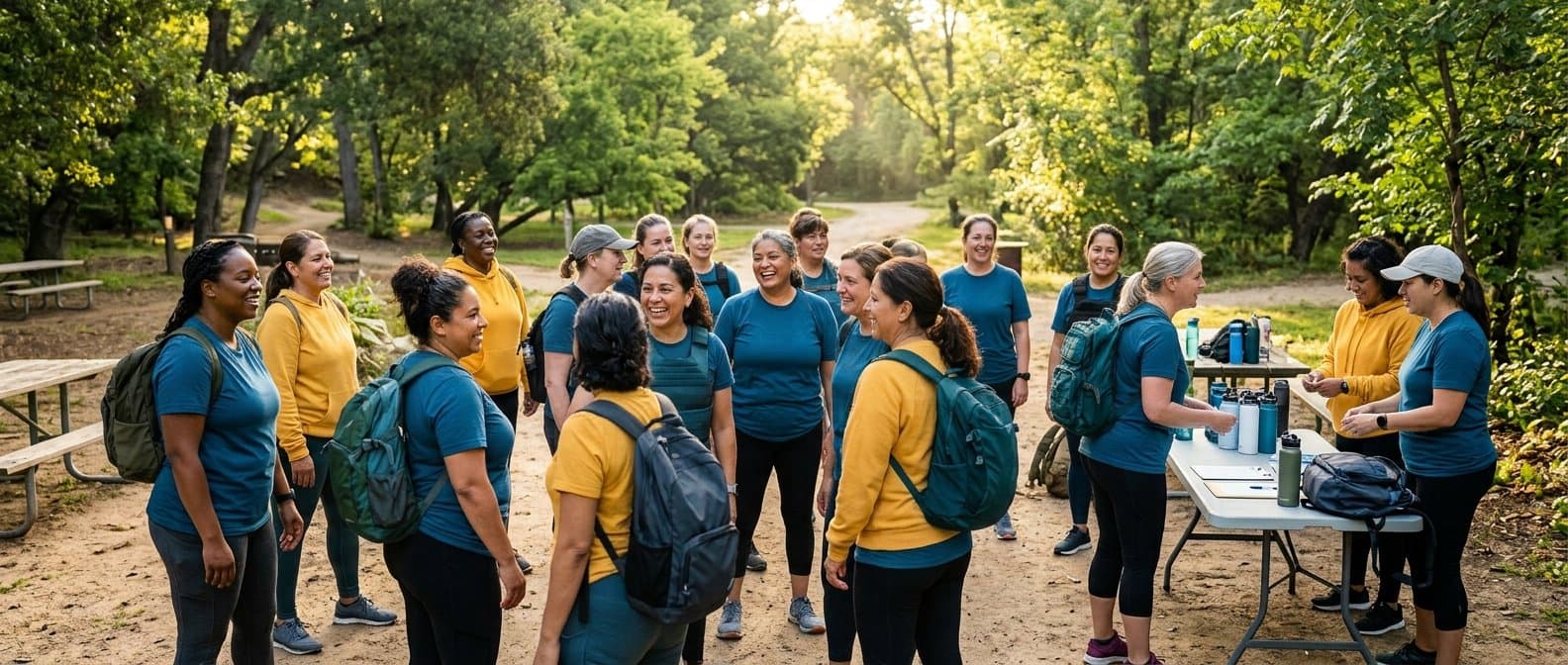
One thing rucking does that running rarely does: it keeps a group together. Everyone walks at a talking pace, so women of different ages and fitness levels can carry side by side. Many carry for a cause, in honor of someone or to raise money for an organization they care about. If you're part of a nonprofit, women's group or workplace, you can host a ruck for your cause. Donations go straight to your organization.
Want to try rucking?
Our guide to how to start rucking walks you through your first ruck, from packing a backpack you already own to how it should feel. Then find your starting weight with our weight calculator and follow the free 4-week plan.