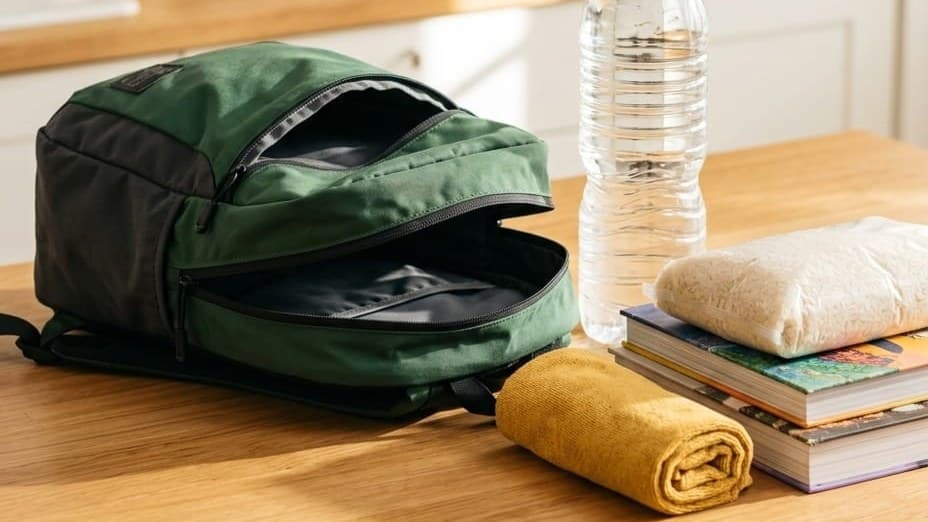
Once you've decided to try rucking, the next question is what to put in the pack. You'll find ruck plates, sandbags and weight bags for sale, and plenty of opinions about each. You'll also find that your kitchen already has most of what you need.
This guide covers what makes a good ruck weight, the household options, ruck plates and sandbags, and how to pack any of them so the weight stays where it should. For how much weight to carry, our weight calculator gives you a starting range.
What makes a good ruck weight
Whatever you choose, a good ruck weight does four things.
- It's dense. Heavy for its size, so the load stays small and close to your body instead of filling the whole pack.
- It's quiet. No rattling, sloshing or clanking with every step.
- It sits high. The weight should rest between your shoulder blades, not down at the bottom of the bag where it pulls your shoulders back.
- It stays put. A load that shifts or bounces tires you out faster and can rub. Snug and still is the goal.
A heavier weight that rides well often feels easier than a lighter one that swings around. So how you pack matters as much as what you pack.
Household options: start with what you have
You don't need to buy anything to start rucking. These all work.
- Water bottles. The easiest place to start. You can add or remove one bottle at a time, and you can drink or pour one out if you want to lighten up mid-walk. They're bulky for their weight, so they suit lighter loads.
- Hardcover books. Flat, dense and quiet. A couple of books stacked against the back panel ride well. Wrap them in a towel to soften the corners.
- Rice, beans or sand in sealed bags. Dense and soft enough to mold to your back. Double-bag them and tape the tops closed so nothing spills, then wrap them in a towel or a cloth bag.
- Canned food. Fine in a pinch, but the edges dig in and cans rattle unless you pack them tightly.
Would you rather carry household weight on your front and back, like a vest? Our DIY weighted vest guide covers the options.
Ruck plates: what they are, pros and cons
A ruck plate is a flat, dense weight, usually iron or steel, shaped to stand upright in a backpack's weight pocket or sleeve. Some have a handle cut into the top so you can lift them in and out. They come in a range of fixed weights.
What women like about them:
- Compact. A plate takes up very little room, so the rest of your pack stays free for a layer, water and your keys.
- Rides high and flat. In a pack with a proper sleeve, the plate sits right against your back and doesn't shift.
- Quiet and quick. Slide it in, zip up, go.
The trade-offs:
- Cost. Plates are an extra purchase, and household weight works just as well while you're finding out whether you like rucking.
- One weight per plate. Moving up means buying another plate, or adding a little household weight around the one you have.
- Your pack needs to hold it. Without a sleeve or a pocket that keeps the plate upright, it can slump to the bottom of the bag. Check this before you buy; our guide to rucking backpacks covers what to look for.
- Hard edges. If the plate presses on your spine, add a layer of padding or a folded towel between the plate and your back.
Sandbags and weight bags
Sandbags and weight bags are fabric shells that you fill with sand or that come with sealed filler bags inside. Some are made to fit in a pack; larger ones are for carrying in your arms or on your shoulder at the park.
The good: they're soft, so they mold to your back without hard edges. Many let you adjust the weight by adding or removing filler. They're also handy if you like to mix your walk with a few carries or lifts.
The not so good: sand is less dense than a metal plate, so a sandbag takes up more room for the same weight. A bag that isn't packed tightly can sag to the bottom of the pack. And cheaper shells can leak, which is one of the most common complaints in reviews of sand-filled gear. Look for sealed inner bags and sturdy stitching.
Which should you choose?
- Just starting? Use what you have. Water bottles, books or bagged rice, wrapped in a towel.
- Rucking regularly and like it? A ruck plate, if your pack can hold it upright, is the tidiest way to carry a steady weight.
- Want soft weight you can adjust? A sandbag or weight bag that fits inside your pack.
None of these is better across the board. The right one is the one that rides high, stays quiet and gets you out the door. If you'd rather carry the weight on your torso than your back, our guide to weighted vests vs rucking compares the two.
How to pack your ruck weight so it doesn't shift
These steps work for any weight.
- Check in first if you need to. Talk to your doctor or physical therapist before you add weight if you have osteoporosis or osteopenia; bone, joint, heart or pelvic floor concerns; or if you're pregnant or postpartum.
- Choose your weight with the calculator. Our weight calculator gives you a starting range. Start lighter than you think.
- Put the weight high and close. Place it against the back panel, between your shoulder blades. If your pack is deep, put a rolled towel or a sweater underneath to lift the load up.
- Fill the gaps. Stuff a towel or a soft layer around the weight so nothing moves.
- Tighten everything. Snug the shoulder straps so the pack sits close to your back, then clip the chest strap and hip belt if your pack has them.
- Do a short test walk. If you feel the weight bounce, sway or press on one spot, stop and repack.
- Know when to stop. Stop or lighten your load if you feel sharp pain, pain that changes how you walk, pelvic heaviness, dizziness or chest discomfort.
For your first full walk, from packing to pace, see how to start rucking. Our guide to rucking shoes and what to wear covers the rest of what you'll need.
Your next step
Your first ruck weight is probably already in your kitchen. Pack it high, pack it snug and start lighter than you think. You can always add more later.
Find your starting range with our free weight calculator, then follow the free 4-week plan to build up one small step at a time. More gear guides are in the Gear Lab.